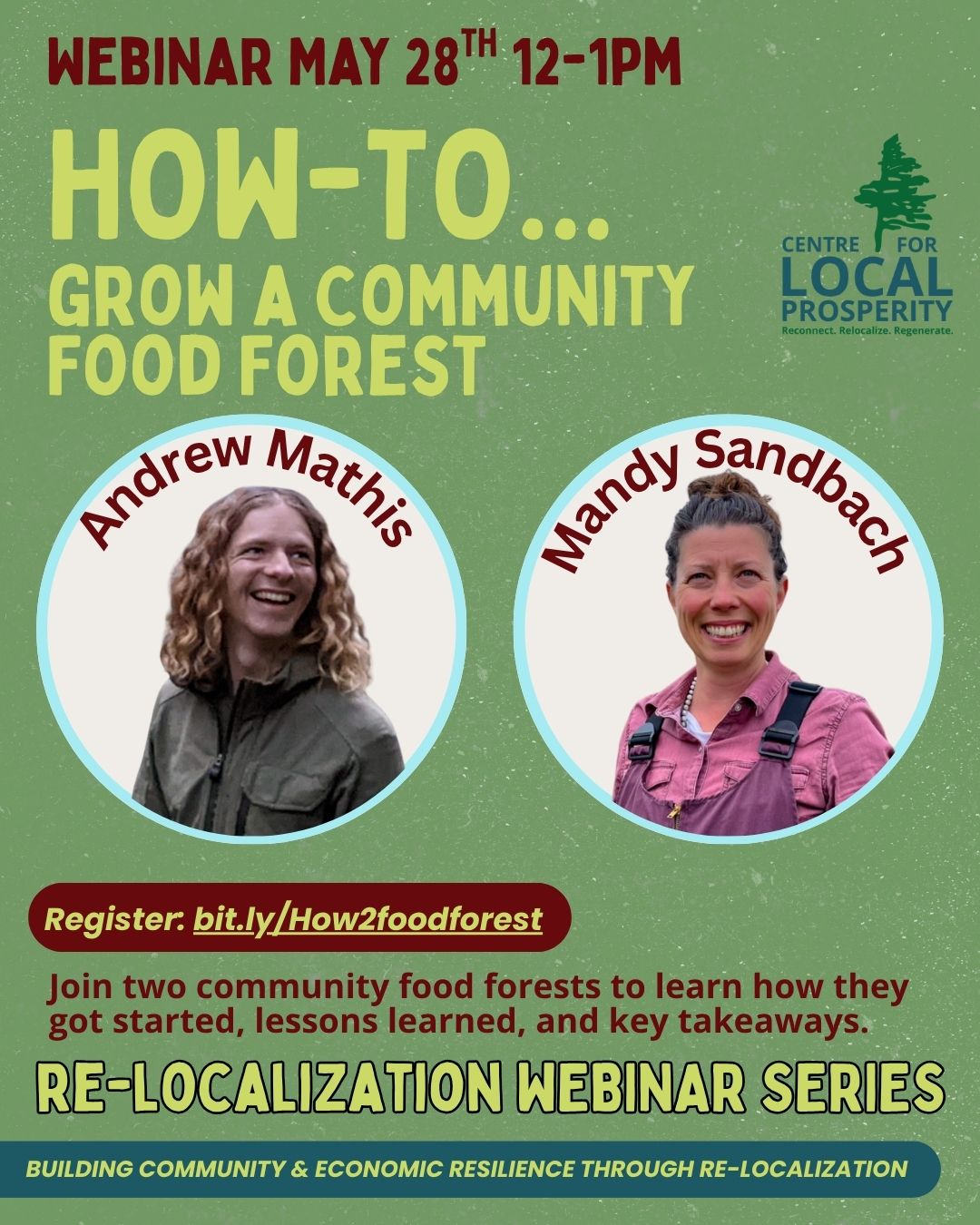
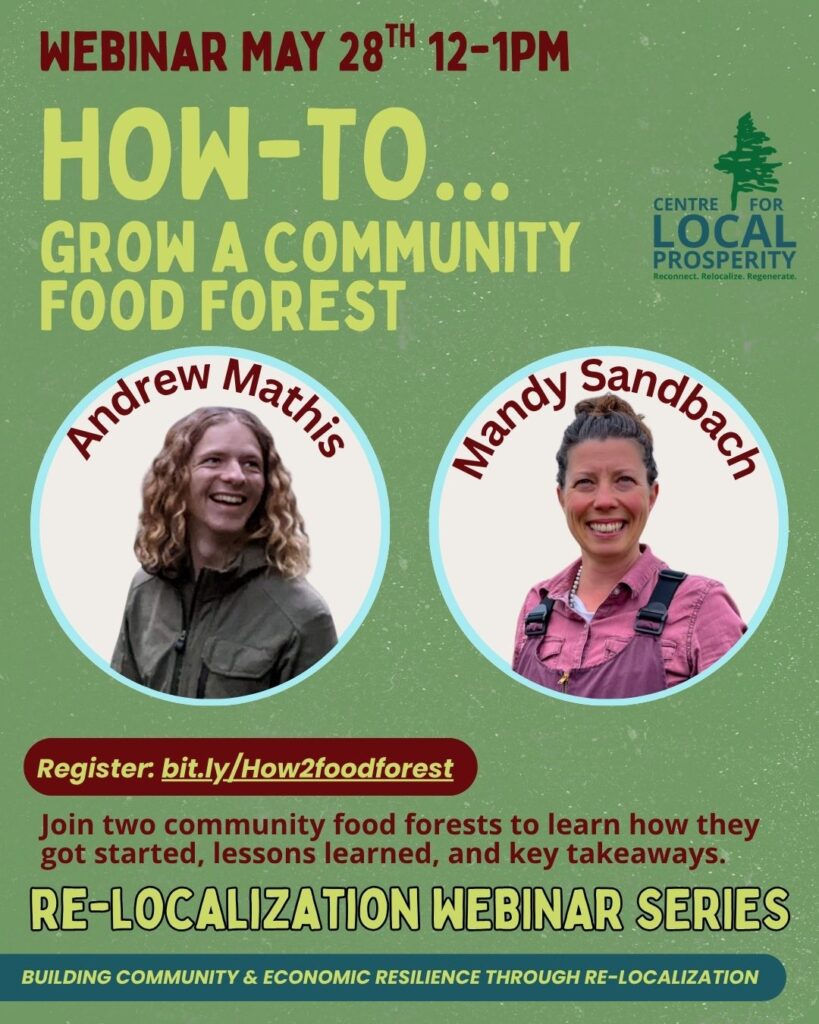
Webinar S2 E2: How-To Grow a Community Food Forest
Thursday May 28th from 12-1pm ADT.
For this webinar, we are talking about Community Food Forests! Community Food Forests are a dynamic planting of perennials including food-producing trees and shrubs, edible fungi, and medicinal plants. These grassroots and community-driven projects are popping up all over in Atlantic Canada, sprouting in unused spaces like meridians, parking lots, school grounds, and backyards. Existing in small towns and large urban neighbourhoods, community food forests are about community members coming together to feed each other, learn about their ecosystems, and participate in long term sustainable community solutions. Community Food Forests are more than just landscapes, they are educational spaces to learn about propagation, seed starting, food processing, and more. Come hear from two community food forest coordinators who can provide insights into how to start a food forest in your community, building partnership, challenges to look out for, and what unexpected joys come from this community initiative.
Let’s get all the community food forests together in one room!
Season 2 of our webinars series takes a ‘how-to’ focus, where we learn how local people are putting big ideas into practice. Episode two of this season welcomes Mandy Sandbach of the Scotsburn Community Food Forest and Andrew Mathis of St. Mary’s Community Food Forest
Bob Cervelli, du Centre pour la prospérité locale, animera la discussion, qui débutera par une interview/table ronde, suivie d'une séance de questions-réponses.
Cette série de webinaires est proposée sur donation – Notre don recommandé est de $10, mais tout montant est apprécié ! Un lien Zoom et une invitation de calendrier vous seront envoyés après votre inscription.
Mandy Sandbach:
Mandy Sandbach of SOULfully SOIL is a permaculture practitioner and longtime community organizer who coordinates the Scotsburn Community Food Forest and supports resilient, relationship-centered food systems through nearly two decades of hands-on experience.
Andrew Mathis:
Dr. Andrew Mathis is a regenerative design educator who seeks to empower people to envision and co-create a hopeful flourishing future for all. Andrew teaches courses and workshops on permaculture, food forest design, and sustainability, and has worked with community groups, First Nations, and schools to design and implement projects that bring people together around growing food. He has been involved with the development of five community food forests and volunteers his time to manage the 0.6-acre St. Mary’s Community Food Forest with the help of summer students. Andrew lives with his wife Anna in an old farmhouse with their children Gibson and Juniper on the Nashwaak in the unceded territory of the Wolastoqiyik. On the weekends they can be found in the garden, tending the bees, or foraging for wild mushrooms.
Contexte du webinaire :
Le monde évolue à un rythme sans précédent, engendrant chez de nombreuses personnes et communautés un sentiment d'incertitude, voire d'inquiétude. Comment réagir face à ce monde en perpétuelle mutation ? Comment renforcer notre autonomie et notre résilience locales, sur les plans social, économique et écologique ? Dans le contexte actuel de volatilité des échanges commerciaux et de droits de douane imposés qui menacent d'aggraver les difficultés financières de nos communautés, nous souhaitons mettre en lumière des exemples fructueux de relocalisation dans notre région !
La relocalisation est un concept et un mouvement visant à devenir plus autonomes dans notre production et notre consommation (tout en réduisant notre dépendance aux chaînes d'approvisionnement éloignées) dans tous les domaines — de l'énergie à l'alimentation, en passant par la finance/l'investissement, les solutions climatiques et bien plus encore.
Cette série se déroulera le dernier jeudi de chaque mois et explorera des exemples de relocalisation dans l'ensemble du Canada atlantique.
Regardez les épisodes précédents ici : https://centreforlocalprosperity.ca/our-projects/webinar-series-building-community-economic-resilience-through-relocalization/
À VOS AGENDAS ! Prochains webinaires :
- May 28th – How-To Grow a Community Food Forest
- 25 juin – Comment organiser un Repair Café