
Tatamagouche and the practice of regenerative economics
October 14, 2026
Gillian Kerr, Board of Directors, CLP
Local Prosperity 2026 offers a starting point for aligning how we live, work and govern with the health of people, communities and the living world.
What is an economy for? The answer becomes tangible when people gather around food, meaningful work, housing, culture and the future of their community. These are the things that make a life possible and a place worth caring for. Economic success should be judged by whether it strengthens those foundations, and by whose lives it improves.
An economy with a clearer purpose
John Fullerton’s Regenerative Economics invites us to reconsider the purpose and design of the economy. He presents a living-systems framework in which economic health depends on relationships, participation, circulation and the capacity to adapt. The economy is embedded in society and the biosphere: degrading either foundation undermines the possibility of lasting prosperity. His principles offer a way to examine the choices that shape economic life. [1]
This perspective challenges the assumption that increasing investment, output or consumption will necessarily produce a better future. Financial viability matters. So do secure livelihoods, fair access to land, healthy ecosystems, cultural continuity and time to care for one another. Progress requires making these values explicit, then changing the rules and practices that determine what receives support.
From August 6–9, 2026, around 300 people gathered in Tatamagouche, Nova Scotia, for Local Prosperity 2026: Local People, Local Solutions. Convened by us at the Centre for Local Prosperity, the Rural Communities Foundation of Nova Scotia and the North Shore Community Connections Society, the conference and festival combined economic discussion with workshops, practical skills, music, community meals and local experiences. [2, 4]
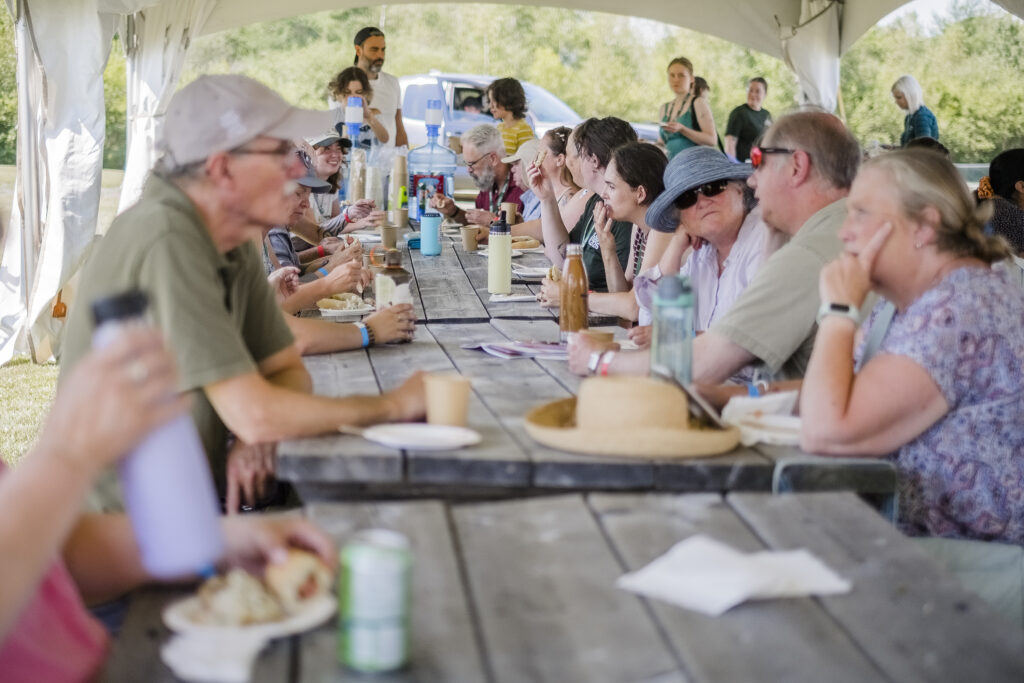
Read through a regenerative lens, the event was a purposeful opportunity to begin practicing a different economy. This is an interpretation of its design and lessons, rather than a claim that the festival established a fully regenerative system. Its importance lies in bringing economic purpose into everyday experience: learning together, sharing skills, supporting local livelihoods and asking what communities want to sustain.
Values become real through relationships and place
Tatamagouche was part of the learning. The festival website highlights its farmers’ market, independent businesses, library, arts spaces and surrounding landscapes. These places help people meet needs, exchange knowledge and build attachment to community.
Holding economic conversations within this setting made the relationship between prosperity and place easier to see. [4]
Tatamagouche is situated on the traditional and unceded lands and waters of the Mi’kmaq. Christopher Googoo’s keynote and Indigenous entrepreneurship discussions emphasized community wellbeing, ownership and self-determination. These contributions remind us that practices of reciprocity and collective responsibility have histories and knowledge foundations that precede contemporary regenerative economics. They deserve recognition on their own terms, with authority over their interpretation and application. [3, 4]
African Nova Scotian leadership also brought land, culture and community decision-making into the discussion. The Reframing Climate Planning session described an approach beginning with residents’ priorities, including food, energy, community spaces, emergency preparedness and cultural preservation. This offers a practical lesson: resilience planning becomes more meaningful when people help define what must be protected and strengthened. [3, 4]
At CLP, we believe relationships deserve sustained investment. Trust makes collective action possible. Building trust takes time, care and resources.
The workshop notes repeatedly return to trust. Food initiatives connect growing and sharing with belonging. Co-operative and community ownership connect economic activity with agency. The Coady Institute’s contribution linked learning and collective action through the Antigonish Movement. Across these examples, relationships are part of the infrastructure that enables people to act together. They require time, care and resources. [3]
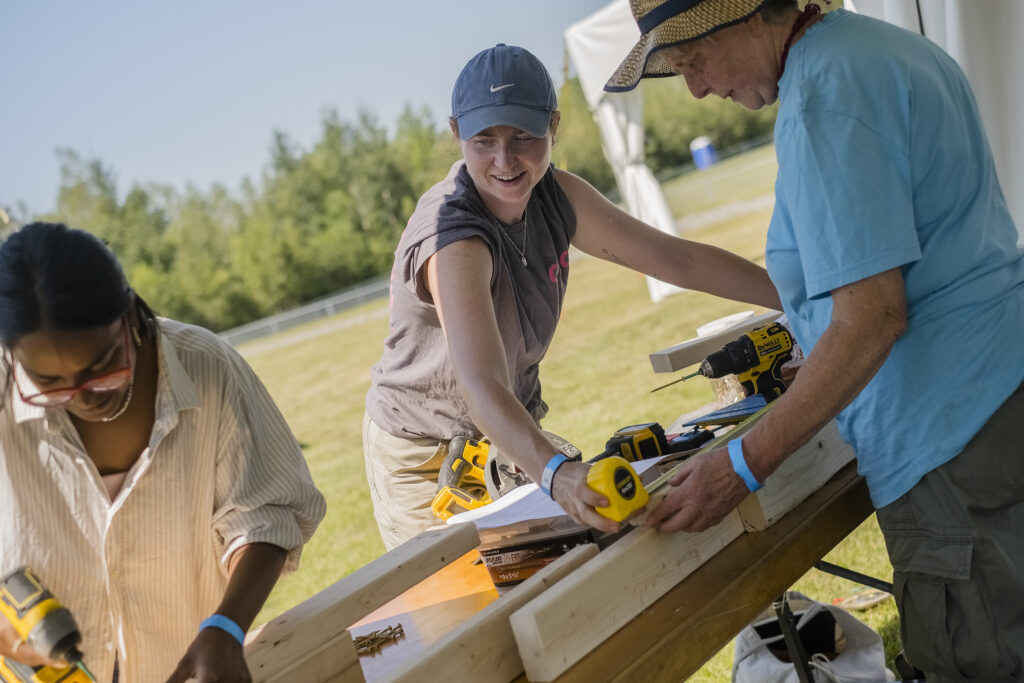
The conference–festival format made space for this wider understanding of wealth. Seed saving, flax processing, repair and making shared practical knowledge. Music and community meals created occasions for connection and enjoyment. These activities matter because economic life includes the skills, culture and relationships through which people meet needs and find meaning. [2]
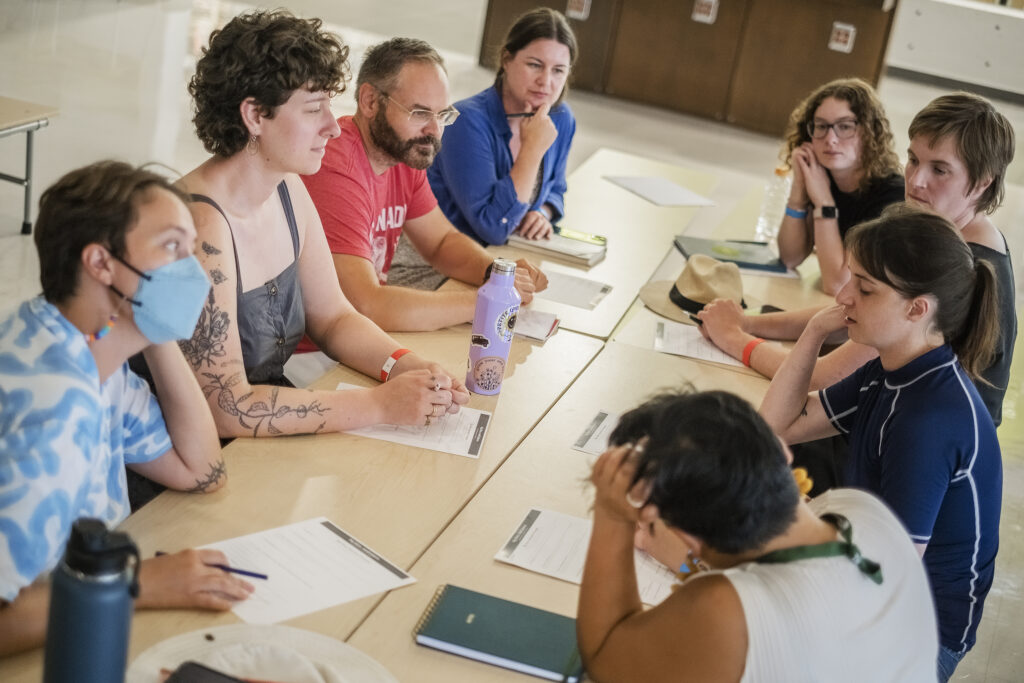
A regenerative approach also asks whose participation is possible. Sliding-scale registration and subsidized tickets supported access. Feedback identified continuing barriers involving timing, transport, scheduling, food and accessibility. Those lessons belong within the economic argument: participation becomes more powerful when people can influence decisions and have the practical means to take part. [2, 5]
Eight principles, one connected practice
Fullerton’s eight principles describe an interconnected pattern. They are useful here as questions for reflection and design, rather than a scorecard certifying the festival. The table connects their meaning with recorded festival themes and proposes ways to carry the learning forward. Principle labels are shortened for readability. [1, 3–5]
| Principle | Festival connection | Practice to carry forward |
| Right relationship | Food, natural assets and community wellbeing were considered together. | Assess effects on people, ecosystems and future generations. |
| Holistic wealth | Culture, skills, belonging and ecological function appeared alongside income. | Recognize multiple forms of value in plans and budgets. |
| Innovation and adaptation | Community initiatives shared experiments; feedback identified improvements. | Test practical changes and revise them through learning. |
| Empowered participation | Community ownership, youth perspectives and self-determination were discussed. | Share authority and address barriers to participation. |
| Community and place | Local venues, livelihoods, histories and landscapes shaped the experience. | Build from local strengths and community-defined priorities. |
| Edge effect abundance | People met across sectors, generations and fields of practice. | Support collaboration where different experience and knowledge meet. |
| Robust circulatory flow | Local purchasing, procurement and community finance were explored. | Circulate money, knowledge and resources more fairly. |
| Dynamic balance | Livelihoods, ecology, care and practical capacity raised connected demands. | Balance enterprise with stewardship, inclusion and time to recover. |
The connections matter as much as the individual principles. Keeping money local achieves little if workers are poorly treated or ecosystems are depleted. Participation is limited when people can speak but cannot shape outcomes.
Innovation becomes more useful when it responds to community needs. The regenerative task is to consider these relationships together.
Natural assets make this connection especially clear. Gillian Kerr’s workshop linked ecosystems, ecological functions, services and community benefits. Forests, wetlands, soils and waterways can support risk reduction, food systems and wellbeing. Their contribution to prosperity calls for stewardship and investment; a monetary estimate alone cannot express their full significance. [3]
From shared values to different economic rules
Community Wealth Building provides practical routes for acting on this broader purpose. The festival report identifies five pillars: democratic enterprise, locally rooted finance, fair work, just use of land and property, and progressive procurement. Regenerative economics helps explain the wider purpose and relationships we should attend to; Community Wealth Building offers ways to change ownership, spending and control. Their connection is useful, while neither framework automatically guarantees ecological health or justice. [1, 2]
The workshop notes suggest concrete places to begin. Schools, hospitals, libraries and municipalities can examine spending they can realistically influence. Communities can explore co-operative enterprises, land trusts and shared food infrastructure. Funders can consider patient capital and support for the work of developing projects and partnerships. These choices affect who can participate, who carries risk and whether benefits remain available over time. [3]
This is also a governance question. A community that owns an asset needs workable arrangements for decisions, responsibilities, maintenance and the distribution of benefits. Local ownership can concentrate power as well as share it. Regenerative practice therefore requires accountability, fair work and ecological limits alongside local wealth retention. Migrant workers, newcomers and people with less income or formal authority belong within the community whose wellbeing matters.
Fullerton’s theory of change connects shifts in worldview with changes to system design and practical work on the ground. Applied to Tatamagouche, this means linking a different story of prosperity with different institutional choices and specific projects. A community food initiative may address an immediate need while also revealing barriers in finance, land access or procurement. Its lessons become more consequential when partners use them to improve those conditions. [1]
For individuals, the starting point may be how we buy, repair, share, work and participate.
For employers, it may be fair employment, purchasing decisions and shared authority.
For public institutions and funders, it may be how budgets, contracts and investment criteria support long-term community health.
Each setting offers choices, but people need enabling conditions to act. Affordability and access must shape the transition; economic change cannot depend on everyone having the money or time to make ideal consumer choices.
Progress means choosing a manageable action and giving it a clear purpose, responsible partners and a way to learn. A procurement pilot, shared space or natural-asset initiative can become a starting point when it is connected to the wider changes needed to sustain it.
What remains after the gathering?
The post event survey provides early evidence of connection and motivation. Ten of twelve attendee respondents, and twelve of thirteen contributor respondents, agreed or strongly agreed that they left feeling part of a broader movement. These are separate, small, self-selected groups. Their responses indicate promising experiences; they do not establish outcomes for everyone who attended or demonstrate lasting economic change. [5]
Feedback also asks for more practical tools, more hands-on learning and fewer competing sessions. Workshops on care and wellbeing raise a related concern: community change depends on people whose energy is finite. A regenerative event should carry these lessons into its own design, including space to reflect, accessible participation and support for the people doing the work. [3, 5]
For CLP and its partners, a useful next step would be to help interested communities turn a few priorities into action, connect them with expertise and resources, and return to the learning after six and twelve months. Assessment could ask whether collaborations continued, decisions became more inclusive, resources circulated more fairly, ecological conditions improved and participants had the capacity to keep going. These are proposed directions, not commitments already agreed by the conveners.
Tatamagouche’s contribution can grow through the decisions that follow. The invitation is to make what matters visible in how we live, work and govern: dignity, belonging, healthy land and water, meaningful livelihoods, cultural continuity and opportunities for future generations. A purposeful gathering helps people begin. Regenerative practice gives that purpose continuity in everyday choices and in the institutions that shape our shared future.
Sources and basis for the write-up
[2] Centre for Local Prosperity. (2026, October 1). Local Prosperity 2026: Local People, Local Solutions — summary and outcomes report. Supplied draft.
[3] Workshop Notes – LP 2026. Supplied rapporteur spreadsheet. Session themes are paraphrased; notes are not treated as verified transcripts.
[5] LP 2026 Post-Event Survey. Supplied workbook: 12 attendee and 13 contributor records, dated September 1–October 1, 2026. Results are reported separately; no unique-person total or overall response rate is inferred.