

- This event has passed.
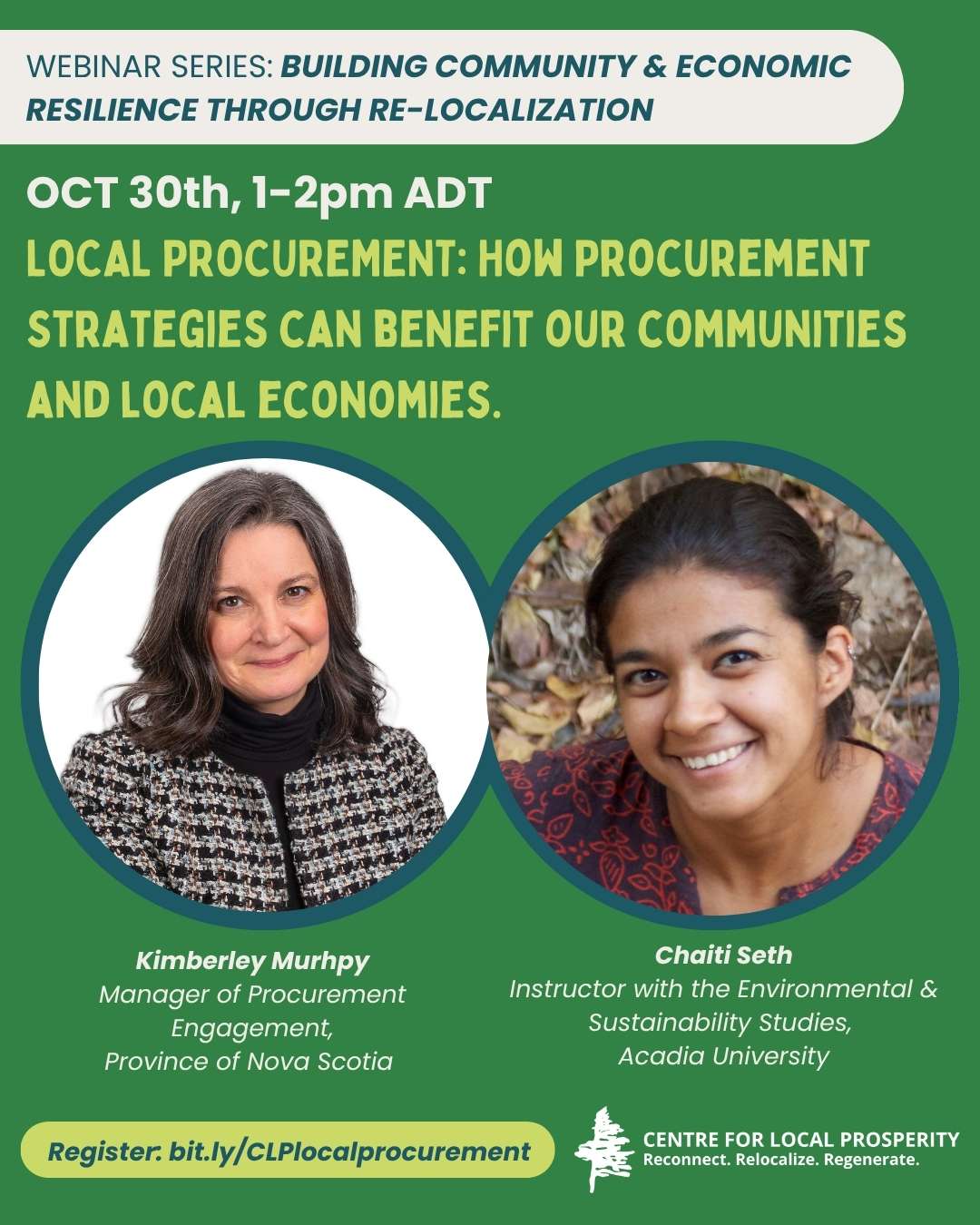
Episode #7: Local Procurement: How procurement strategies can benefit our communities and local economies.
Webinar #7: Local Procurement: How procurement strategies can benefit our communities and local economies
Local procurement is when public institutions (eg. hospitals, schools) prioritize local suppliers when procuring goods and services. If these large anchor institutions commit just a small percentage of their budgets to local procurement there are significant benefits for our local economies and community relationships. Episode 7 in our series welcomes Kimberley Murphy and Chaiti Seth for a conversation on the potential for local procurement for our communities. We will begin with an interview/panel discussion, followed by a Q&A.
This webinar series is by donation – our recommended donation is $10, but any amount is appreciated! A Zoom link and calendar invitation will be sent after you register.
Register (by donation) here: https://www.zeffy.com/en-CA/ticketing/webinar-7-local-procurement
Kimberley Murphy – Manager of Procurement Engagement for Nova Scotia Government has worked in the Procurement division for the past 19 years. In her current role as Manager of Procurement Engagement, she is responsible for the implementation of a Sustainable Procurement Strategy for the province as well as developing and delivering information on the policies and processes of public procurement for internal and external groups. Included in that group is the supplier community where Kimberley has focused much of her efforts to engage suppliers in the public procurement process. Kimberley is currently serving her 3rd term as president of the Canadian Public Procurement Council.
Chaiti Seth – Instructor with the Environmental & Sustainability Studies, Acadia University is a mother, farmer, researcher, and experiential educator from India currently living in Mi’kma’ki. She is an Instructor with the Environmental & Sustainability Studies program at Acadia University and learns, writes, and teaches about sustainability, food systems, transformative learning, and the inner work and community practice of healing for equity and social change. She currently lives with her partner and children on a small farm on south mountain above Sikunme’katik (the Gaspereau river).
Webinar context:
The world is changing at an unprecedented pace, leaving many individuals and communities with a sense of uncertainty, and in many cases, worry. How do we respond to this rapidly changing world? How do we strengthen our local agency and resilience, socially, economically, and ecologically? In our current context of trade partner volatility and imposed tariffs that threaten to worsen the financial realities within our communities, we want to shine a light on thriving examples of re-localization in our region!
Re-localization is a concept and movement with an aim to become more self-reliant in our production and consumption (while reducing reliance on distant supply chains) in every category — from energy, to food, to finance/investment, to climate solutions, and beyond.
This series will be held on the last Thursday of each month and will explore examples of re-localization across Atlantic Canada.